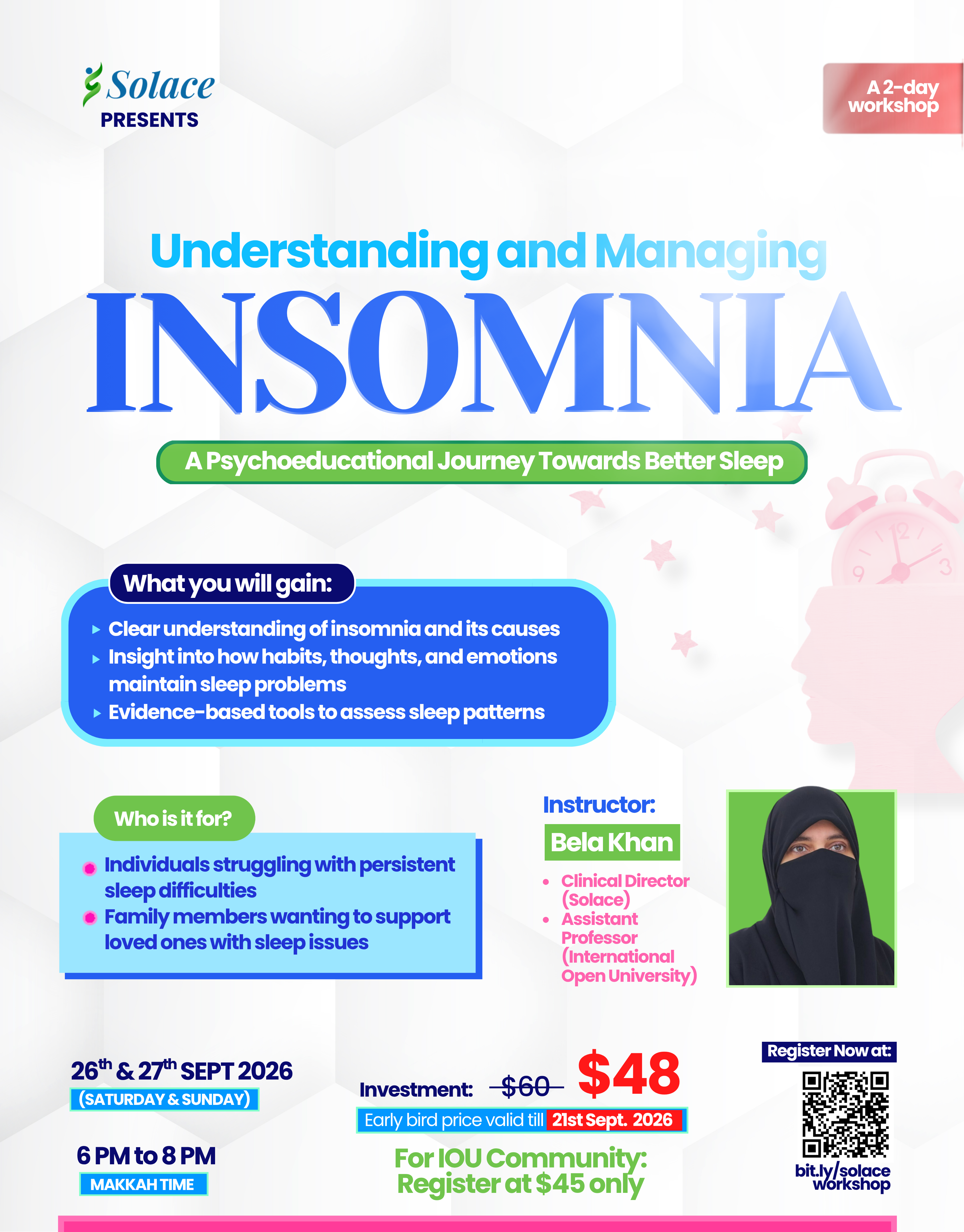
Understanding and Managing Insomnia: A 2-day Workshop with Solace’s Clinical Director, Bela Khan.
Want some peaceful sleep for yourself or a loved one? This is for you!
Persistent difficulty falling asleep, staying asleep, or waking earlier than intended can affect emotional well-being, focus, physical health, relationships, and everyday functioning. Constantly worrying about sleep can make it even harder to sleep.
“Understanding and Managing Insomnia” is a two-day online psychoeducational workshop designed to help participants understand their sleep difficulties. Once the understanding it developed, we will move to practical, evidence-based strategies for improving sleep. The workshop will help participants understand what causes insomnia, what keeps it going, and how daily habits, thoughts, and emotions affect sleep.
Through guided self-assessment, participants will examine their current sleep patterns and identify factors that may be contributing to their difficulties. They will learn how to use a sleep diary and insomnia-screening tools to monitor their sleep more accurately. The workshop will then introduce practical approaches drawn primarily from Cognitive Behavioural Therapy for Insomnia (CBT-I), including sleep hygiene, lifestyle modification, stimulus control, sleep scheduling, and strategies for managing sleep-related thoughts and anxiety.
By the end of the workshop, participants will be able to develop a realistic personal sleep-improvement plan based on their individual patterns, needs, and circumstances.
Workshop Objectives:
By the end of the two-day workshop, participants will be able to:
- Understand insomnia and distinguish it from occasional sleep disturbance.
- Recognize common psychological, behavioural, lifestyle, and environmental contributors to insomnia.
- Understand how unhelpful sleep habits and sleep anxiety can maintain insomnia.
- Assess their sleep patterns using a sleep diary and insomnia-screening measures.
- Identify personal factors that may be interfering with healthy sleep.
- Apply appropriate sleep-hygiene and lifestyle strategies.
- Use stimulus-control techniques to strengthen the association between bed and sleep.
- Understand the principles of sleep scheduling and the careful use of sleep-restriction strategies.
- Identify and manage unhelpful thoughts, worry, and anxiety related to sleep.
- Develop an individualized and sustainable sleep-improvement plan.
- Recognize when sleep difficulties require medical or professional assessment.
Dates: 26th and 27th September 2026 (Saturday & Sunday)
Time: 6 PM to 8 PM Makkah time
Investment: $60 $48
Early bird price valid till 21st September 2026
If you are a Solace workshop alumnus, check your inbox for an exclusive discount coupon code.
IOU Community can avail a flat 25% discount. Email us at contact@solace-services.com for the details.
Note: Recordings and resources will be provided.
Certification: A certificate of participation will be provided.