

Specialization Series #4
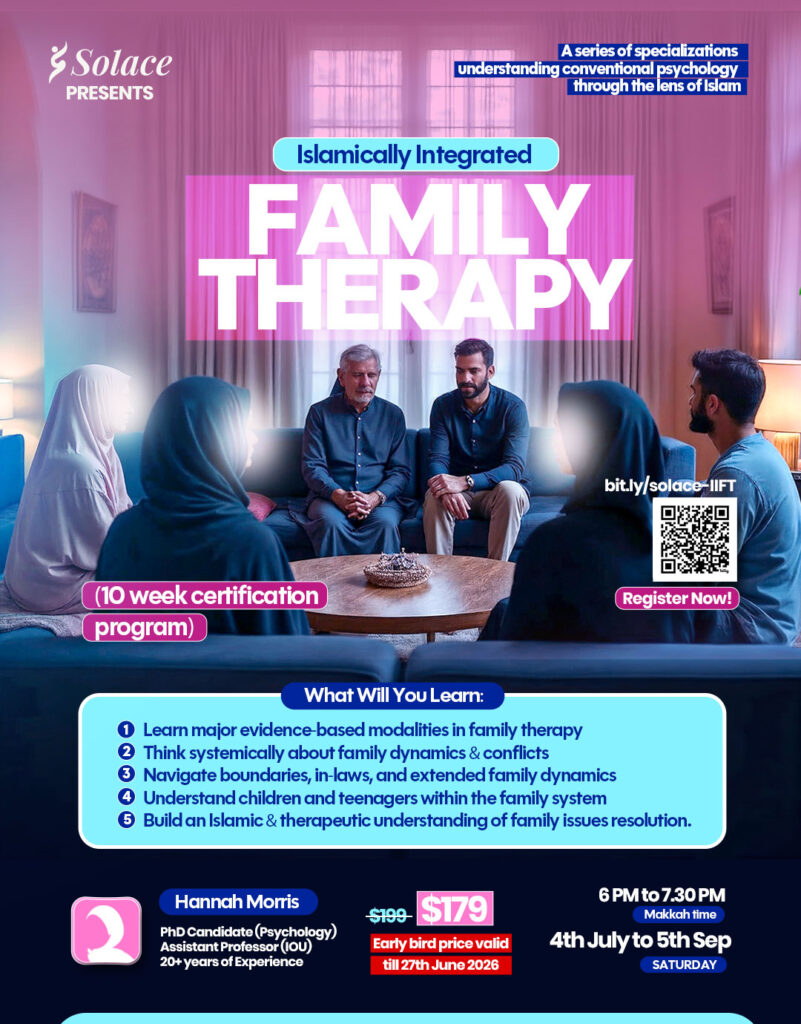
Islamically Integrated Family Therapy
Introduction to the course
This course offers a compassionate, evidence-based introduction to family therapy through an Islamic psychological lens. It is designed for both professionals and non-professionals who want to better understand family dynamics, strengthen relationships, and navigate challenges within families using both contemporary psychology and Islamic principles.
Drawing on established family therapy models alongside the Qur’an, Sunnah, and Islamic concepts of family, responsibility, mercy, and balance, the course bridges theory and real-life application, whether in professional practice or everyday family life.
Objectives of the Course
By the end of this course, participants will:
- Gain a clear and accessible understanding of the major evidence-based approaches to family therapy
- Learn how family systems function and how patterns, roles, and relationships affect individual well-being
- Develop practical skills and insights to support individuals, couples, and families in everyday and professional contexts
- Explore how Islamic teachings and values can be meaningfully integrated into understanding family relationships and conflict
- Learn to think systemically, rather than individually, when approaching family challenges
- Build both a therapeutic and Islamic framework for navigating common family issues such as marriage conflict, parenting challenges, boundaries, and extended family dynamics
Who This Course Is For
- Students of psychology, counselling, or related fields
- Therapists and practitioners seeking an Islamic perspective on family therapy
- Parents, spouses, educators, community workers, and caregivers
- Anyone interested in improving family relationships, communication, and emotional well-being within an Islamic framework
- Individuals who want structured psychological insight without needing prior clinical training
Note: No previous background in psychology or therapy is required.
Units Covered
Unit 1: Introduction to Family Therapy – Understanding families as systems and why individual issues rarely exist in isolation
Unit 2: Systems Theory and Working with Muslim Families – Applying systems thinking within Islamic family and cultural contexts
Unit 3: Marriage Therapy – Gottman’s Research (Part 1) – Foundations of healthy marriage, communication, and conflict patterns
Unit 4: Marriage Therapy – Pragmatic Experiential Therapy for Couples (Part 2) – Emotional engagement, attachment, and lived relationship dynamics
Unit 5: Marriage Therapy – Pragmatic Experiential Therapy for Couples (Part 3) – Applying experiential techniques to real marital challenges
Unit 6: Bowen Family Therapy – Boundaries, differentiation, in-laws, and extended family relationships
Unit 7: Structural Family Therapy – Understanding family roles, hierarchies, patterns, and genograms
Unit 8: Working with Children and Adolescents – Developmental considerations, parenting styles, and family influence
Unit 9: Therapeutic Considerations When Working with the Muslim Community – Cultural, spiritual, and ethical considerations in family support
Unit 10: Integration, Reflection, and the Future of Islamic Family Therapy – Bringing it all together and exploring emerging directions in the field
What to Expect
- Spiritual & Psychological Growth: Participants will deepen their understanding of family relationships through both psychological theory and Islamic wisdom, with reflections that are relevant to personal life as well as professional settings.
- Practical & Actionable Insights: The course focuses on real-world application – offering tools, concepts, and strategies that participants can use within their own families, communities, or clinical work.
- Interactive Learning: Sessions include discussion, reflection, and applied exercises designed to build confidence in understanding and using these ideas – no prior therapy training required.
- Community & Shared Learning: Participants will learn alongside others who are interested in faith-based psychology, creating a supportive and reflective learning environment.
Certification
Participants will receive a certificate of participation upon successful completion of a 20-Mark MCQ exam.
Course Duration
4th July 2026 to 5th Sept 2026 (10 weeks)
Time
6 PM to 7:30 PM Makkah Time
Day
Saturday
Investment
$199 $179
(Early bird price valid till 27th June 2026)
Special discount for IOU students and alumni – 15% OFF. Email to contact@solace-services.com for the exclusive COUPON code.
Disclaimer: At Solace-Islamically Integrated Mental Health Services, we collaborate with a diverse range of instructors to deliver the courses. While Solace endorses the overall qualifications and expertise of each instructor, the integration of psychological concepts with Islamic principles, including specific interpretations and detailed religious perspectives, reflects the individual understanding of each instructor. Solace assumes no responsibility for any discrepancies or variations in the application of these principles or interpretations presented in the course material.
Important Note
Please note that this is a psychoeducational program and does not authorize any non-specialist to do therapy/counselling. Any such attempt by the individual is his/her own responsibility and Solace takes no responsibility for such an action.
Instructor

Hannah Morris
is originally from the UK and is working as a Senior Lecturer and Instructor at the International Open University (IOU). She has a Bachelor’s degree in Psychology, a Masters in Health Psychology and is currently completing her PhD. She has over 10 years of experience working in health and social care settings in the UK, USA and Ireland. She has primarily worked in secure psychiatric hospitals housing adults with enduring mental health problems and forensic histories, and in residential settings for children and adolescents with behavioral and emotional difficulties.