

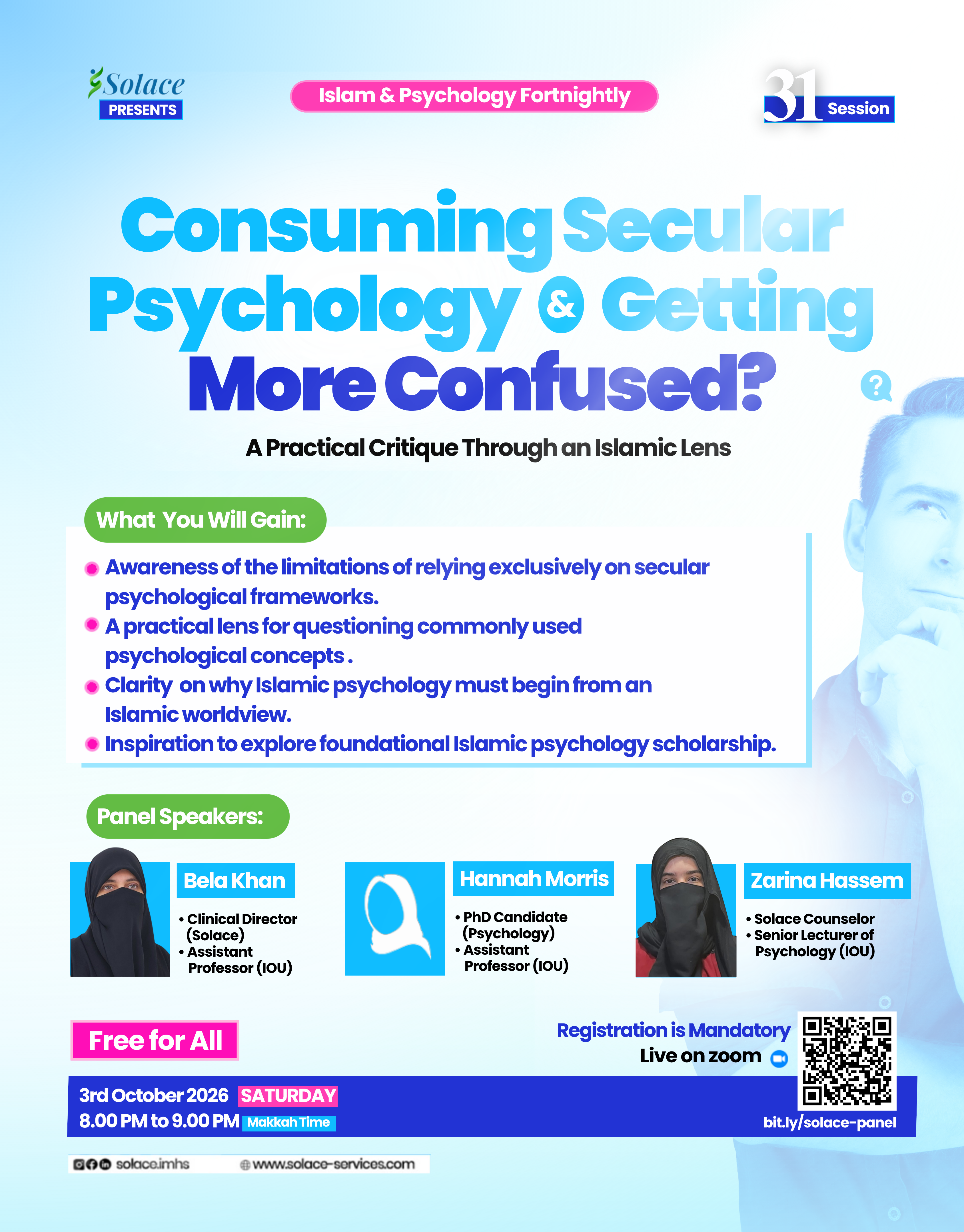

Consuming Secular Psychology and Getting More Confused?

Fortnightly Webinar - Consuming Secular Psychology and Getting More Confused?

Step 1 of 2

Contact Details

Name(Required)
Email(Required)
Please add your country code. (Example: +60)

A Practical Critique Through an Islamic Lens

Muslims today have more access to psychological knowledge than ever before.

We know the language of trauma, attachment, boundaries, emotional regulation, identity, self-esteem, and healing.

Yet many of our individual and collective struggles remain.

So we need to ask:

Can psychological frameworks developed outside an Islamic worldview fully explain the Muslim human being?

What happens when concepts about the self, happiness, suffering, relationships, morality, and healing are adopted from the West without critically examining the assumptions behind them?

And if revelation, the soul, worship, accountability, and the purpose of life are absent from the framework, are we working with a complete understanding of human psychology?

If these questions sparked your curiosity, then we have something coming up for you.

In our upcoming Solace Fortnightly Webinar, three Solace instructors, Bela Khan, Hannah Morris, and Zarina Hassem, will join us for a thought-provoking discussion on how Muslims can engage critically with modern psychology without accepting every assumption that comes with it.

Together, we will explore the strengths and limitations of dominant secular psychological frameworks and examine why a Muslim approach to psychology requires more than simply adding Islamic terminology to existing models.

We will also explore a deeper concern:

If the frameworks we rely upon do not fully account for the spiritual, moral, relational, and communal dimensions of Muslim life, can they adequately address the challenges faced by Muslim individuals and the Ummah?

We are not rejecting everything Western psychology has to offer.

Instead, we are developing the ability to distinguish valuable psychological knowledge from the philosophical or cultural assumptions that may accompany it.

The discussion will highlight why Muslims need an intellectual foundation rooted in revelation from which to evaluate psychological knowledge.

This webinar is for anyone who wants to move beyond simply consuming psychological ideas and begin asking a more fundamental question:

From what understanding of the human being should psychology begin?

Key objectives:

  • Greater awareness of the limitations of relying exclusively on secular psychological frameworks for Muslim individuals and communities.

  • A practical lens for questioning commonly used psychological concepts rather than accepting them uncritically.

  • Greater clarity on why Islamic psychology must begin from an Islamic worldview rather than simply adding Islamic elements to existing psychological models.

  • Inspiration to explore foundational Islamic psychology scholarship in greater depth.

Who is it for?

  • Psychology students and mental health professionals who want to critically evaluate the frameworks they study and use.
  • Muslims interested in understanding mental health through an Islamic worldview. 
  • Counselors, educators, imams, and community workers supporting Muslims through emotional and psychological struggles.
  • Students and professionals interested in the growing field of Islamic psychology. 
  • Anyone who has wondered whether contemporary psychology fully understands a human being. 

📅Date: 3rd October 2026 (Saturday)

⏰Time: 8 pm Makkah Time

💵Investment: Your time.

Register now!

Spread the word and share this with your family and friends as a ṣadaqah jariyah (a means of ongoing reward), insha’Allah!

What is Islam & Psychology Fortnightly?

The rate at which the impact of secular psychology is expanding is unprecedented in this digital age. Every other person, channel, and platform promotes and advocates ideas for solving life problems. However, the assumptions and the principles bombarded upon us are flawed and twisted. Consequently, it makes us question the degree to which we should apply it in our lives, as much of the advice being showered upon us does not meet Islamic values. Thus, bridging this gap between the modern discourse on psychology and Islamic principles has become the urgent need of the hour. 

This is where ‘Islam & Psychology Fortnightly’ comes in!

The integration of Islamic values with contemporary psychology practices makes Solace unique in this field. With this exclusively curated fortnightly webinar series, you can deepen your understanding of key psychological issues and concerns, and learn how these can be navigated on a day-to-day basis without compromising your religious values.  

Share this initiative with anyone who would benefit from such discussions, and help spread the vision of Solace to every corner of the globe.

Tag us on your socials and let us build and expand our community together.

Instagram: https://www.instagram.com/solace.imhs/ 

Facebook: https://www.facebook.com/solace.imhs

LinkedIn: https://www.linkedin.com/company/solace-islamic-mental-health-services/ 

For any inquiries, please contact us at contact@solace-services.com

About the Speaker

Bela Khan is an Assistant Professor of Psychology at the International Open University, known for integrating Islamic principles with psychological approaches. Having extensively studied the Quran, Hadith, and Fiqh from various schools, she offers a unique approach to psychology through the divine lens of Islam, making it meaningful and relatable to Muslims worldwide. She is also serving as the Clinical Director of Solace, an Islamic mental health service. Her Islamically Integrated Life Coaching (IILC) course empowers individuals to help others overcome daily life challenges and lead more purposeful lives. Graduates of this course are working globally, inspiring meaningful change in their communities.

About the Speaker

Hannah Morris is originally from the UK and is working as a Senior Lecturer and Instructor at the International Open University (IOU). She has a Bachelor’s degree in Psychology, a Masters in Health Psychology and is currently completing her PhD. She has over 10 years of experience working in health and social care settings in the UK, USA and Ireland. She has primarily worked in secure psychiatric hospitals housing adults with enduring mental health problems and forensic histories, and in residential settings for children and adolescents with behavioral and emotional difficulties.
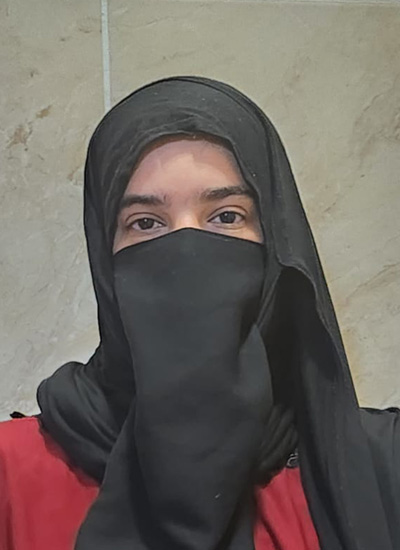
About the Speaker

Zarina Hassem is a South African psychologist who has been practising and teaching in the field of psychology for over 20 years. She was trained in psychology at the University of Witwatersrand, Johannesburg. Zarina also majored in English literature in her studies and writing and reading have always been something that she is passionate about. She has written two fictional books with the aim of getting Islamic psychological messages across to a general audience. In addition, she has co-authored a book on dealing with trauma in Islamic counselling and currently working on research and writing in the field.