

Specialization Series #2
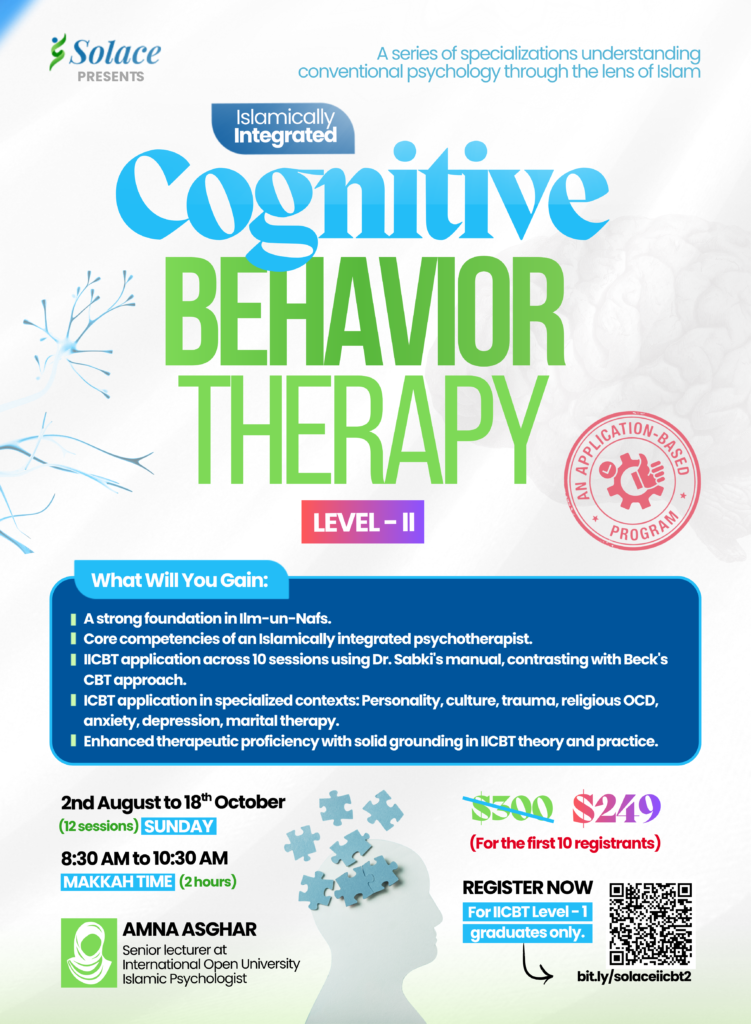
Islamically Integrated Cognitive Behavioural Therapy- Level 2
Introduction to the course
In IICBT- Level 1, students were equipped with the knowledge of applying CBT in practice from session 1 till termination, to infuse an Islamic perspective. Within the Islamic psychology paradigm, such a method is known as “indigenization from without”, this means that an already existing secular model, which is not inconsistent with Islamic teachings, is learnt and theorized as our base model, and then we integrate the Islamic perspective into it. This was primarily the approach carried out in IICBT-Level 1. This approach is effective, but here our foundation is built on a secular model that we have theorized from the outset, is incomplete and has flaws, and therefore, in the IICBT-Level 1, the approach was to address those gaps and fill them with Islamic integration.
In IICBT- Level II, students will be taken one step ahead and familiarized with an “indigenization from within” experience. Students will explore the wisdom of Muslim scholars and their therapeutic models, deepen their understanding of ilm‑un‑nafs (study of the psyche), and develop competencies of an Islamically integrated psychotherapist. This training covers personality, clinical conditions, and situational therapy – including areas like marital counseling – all fully integrated with Islamic principles.
Simply put, level 1 focused on the traditional CBT model and grounded students in theory. Level II will be built on the foundations of Islamic psychology with an application-based approach, thereby enhancing your skillset and making you a proficient and advanced IICBT practitioner.
Objectives of the course
By the end of this course, participants will:
- Build a foundational understanding of Ilm-un-Nafs.
- Be equipped with the competencies of an Islamic integrated psychotherapist.
- Be familiarized with a new model, i.e., IICBT by Dr Zuraida A. Sabki (2018), the foundations of which have been covered in IICBT-I, but step-by-step and in-depth application in a therapy setting will be taught in level II.
- Learn IICBT application across 10 sessions through the manual by Dr Zuraida Ahmad Sabki, M.D., as opposed to CBT practice carried out in therapy settings as proposed by Aaron T. Beck.
- Learn the IICBT application in specialized circumstances: Trauma, religious OCD, anxiety, depression, and marital therapy, where each of the said disorders and conditions will be thoroughly analyzed from their diagnostic criteria and etiology towards their treatment from Islamic integrated cognitive behavioral therapy.
- Enhance their therapeutic proficiency with a solid grounding in IICBT theory and practice.
What to expect
Spiritual and Psychological Growth: Explore the application of Cognitive Behavioral Therapy integrated with Islamic teachings with different clientele.
Actionable Insights: Receive tools and strategies that are practically applicable and spiritually enriching.
Interactive Learning: Engage in discussions and practical activities to apply these insights effectively.
Community Building: Connect with a like-minded community interested in a faith-based approach to psychology.
Units Covered
Session 1: Proposed Competencies of an Islamically Integrated Psychotherapist.
Session 2: Muslim philosophers’ role in the development of the field of psychology with a main focus on the role of Abu Zayd Al-Balkhi and Imam Ghazali from a cognitive psychology perspective.
Session 3: IICBT Manual by Dr.Zuraida Ahmad Sabki, M.D.- Part 1: Rapport, assessment, introduction, behavioral activation, walking by faith, identifying unhelpful thoughts
Session 4: IICBT Manual by Dr.Zuraida Ahmad Sabki, M.D. – Part 2: Challenging unhelpful thoughts, dealing with loss, coping with spiritual struggles
Session 5: IICBT Manual by Dr.Zuraida Ahmad Sabki, M.D. – Part 3: Gratitude, altruism, generosity, stress-related and spiritual growth, hope, and relapse prevention.
Session 6: Personality Guided Therapy: Five-factor personality model and personality as an adjunct to assessing mental morbidity during diagnosis and treatment.
Session 7: Considering Client & Culture Perspective in Therapy: Importance of including cultural sensitivity and mindfulness about collectivism vs individualism in viewing morbidity and navigating healing within this dynamic.
Session 8: IICBT Application for Clinical Depression & Bipolar Disorder
Session 9: IICBT Application for Anxiety
Session 10: IICBT Application for Religious OCD
Session 11: IICBT Application for Marital Therapy Including Intimacy Therapy Within Islamic Adaab of Qinayah
Session 12: IICBT Application for Trauma
Disclaimer:
At Solace-Islamically Integrated Mental Health Services, we collaborate with a diverse range of instructors to deliver the courses. While Solace endorses the overall qualifications and expertise of each instructor, the integration of psychological concepts with Islamic principles, including specific interpretations and detailed religious perspectives, reflects the individual understanding of each instructor. Solace assumes no responsibility for any discrepancies or variations in the application of these principles or interpretations presented in the course material.
Certificate
Participants will receive a certificate of participation upon successful completion of the final assignment.
Course Duration
2nd August 2026 to 18th October 2026 (12 weeks)
Day
Sundays
Timings
8:30 am to 10:30 am (Makkah time)
Investment
$300 ($249 for first ten registrants)
Note: This course is for IICBT-level 1 graduates.
Attendance Policy
Attendance is not compulsory but highly recommended. Recordings and resources will be provided.
Important Note
Please note that this is a psychoeducational program and does not authorize any non-specialist to do therapy/counselling. Any such attempt by the individual is his/her own responsibility and Solace takes no responsibility for such an action.
Instructor

Amna Asghar
is an Islamic Counselling Psychologist at Solace Islamic Mental Health Services. She has an experience of conducting Islamic integrated CBT in her own counselling work for over a decade with successful remission rates, which she owes to the integration of Islam into the CBT methodology. She has developed teaching material of CBT approaches for mood disorders for International Open University. She is eager to teach and train individuals seeking to acquire careers in the field of CBT, with emphasis on integrating Islamic teachings with the mainstream CBT methodology.